

“Think globally, shop locally.” It’s a maxim that applies to buying environmentally-mindful gifts as much as it does to supporting neighborhood shops and farmers markets.
So, Ho Ho!!, if your holiday giving includes donating to big name national and international wildlife organizations, why not also consider the gifts available from your local and regional wildlife centers?
If you’re reading this article, chances are you’re somebody who has brought injured or orphaned wildlife to your local sanctuary … or scrambled to find a licensed rehabilitator able to accept an animal you’re determined to help.
Well, those local sanctuaries and hard-pressed rehabbers rely on fundraisers similar to the symbolic adoptions their larger, better known counterparts promote.
Except, instead of generally contributing toward the conservation of an entire endangered species, their adoption kits are often more uniquely personal, pairing a gift recipient’s name along with the name, photograph and backstory of the specific animal benefiting from your generosity.

The personal nature of these kits reflects the fact that the featured animal is receiving expert care before release ~ or is a permanent resident whose circumstances preclude a return to the wild.
Birds in particular populate the permanent resident category as the injuries that land them in a local wildlife clinic (damaged wings from car collisions for instance) can prevent returning them to the wild. But that doesn’t mean they’re reduced to a lifetime of bored confinement. No indeed, these feathered friends in need are often trained to work as Animal Ambassadors.
For example, the Mountsberg Raptor Center operated by Halton Conservation of Burlington Ontario reports it is “home to more than 15 species of birds of prey.”

The center’s greeting page states: “Many of these birds have permanent injuries, often caused by human activity, which have left them incapable of surviving on their own in the wild. In addition to caring for these raptors the Raptor Centre provides educational programs so that people can learn more about birds of prey, how to share our environment with these birds and how to reduce our impacts on them.”
Meanwhile, the funds raised through Halton Conservation’s Adopt a Raptor program help enable its raptor center to continue vital “conservation through education” work.

“Educate, educate, educate.” *
In addition to featuring more personalized adoption packets, many community-based conservation centers enable their supporters to give interactive gifts. A chance to “ride-along” with staff returning a recovered animal to the wild, sanctuary tours, nature classes and arts and crafts programs all bolster community engagement.

For instance, along with its traditional Adopt-a-Wolf programs, The Wolf Conservation Center of New York also offers distance learning sessions, webinars and backyard Nature Activity Guides for children. All proceeds benefit the center’s wolf conservation and public education work.

Locating Local Groups Online
Wondering how to be sure your local wildlife centre or conservation group is making best use of your gift? The Human Society of America offers this excellent state by state search tool. As does the US Fish and Wildlife Service . If you live in Canada you can search Good Works Canada’s directory of environmental groups, organizations, networks and associations.
Make a habit of reviewing the Home and or About US pages of the organizations you’re considering. Those that are authorized and licensed to perform the work they say they’re doing will clearly note that in a visible location. It’s also a good idea to run the credentials of any unfamiliar charities through Charity Navigator. Mind you, it’s worth noting many worthwhile organizations are simply not set up to file the particular IRS forms this charity evaluator requires. Even so, Charity Navigator is a generally useful way to confirm accountability and results.

Search tools at the ready open, I was curious to see who might be helping wildlife in the state I grew up in. A quick search of: “Wildlife Rescue Organizations in New Jersey” and discovered this entirely new to me endeavor: Woodlands Wildlife Refuge.

This state licensed wildlife rehabilitation and release refuge, founded in 1986, seeks to educate New Jersey’s residents about the “habits and habitats” of the state’s local wildlife. As it operates as a non-profit charitable corporation with no state or federal funding, items like the plush bears available at its online gift shop help fund success stories like the one featured in this video…
If searching wildlife organizations populating the state I grew up in turned up such an interesting find, I wondered who might be beavering away where I live now. It turns out there’s a preserve dedicated to “conservation, education and environmental literacy” not more than five miles from my house. Its on-site shop offers guides to local flora and fauna, children’s books, wildlife hand puppets and holiday ornaments. The same charming wildlife-themed fare you can find at almost any online nature shop but that’s not the point.
The point is, if you think to search locally, that children’s book or plush toy puppet you might purchase elsewhere can lend a hand to the good people working to benefit the wildlife living in or close to your own backyard.

The Holidays Can Sparkle With Wishes Come True

Helpful options beyond symbolic adoptions and sponsorships.
The practical-minded recipients on your gift list might appreciate knowing you’ve made a tangible contribution in their name. Donating food, bedding or litter or any number of necessary every-day items can be an especially helpful act.
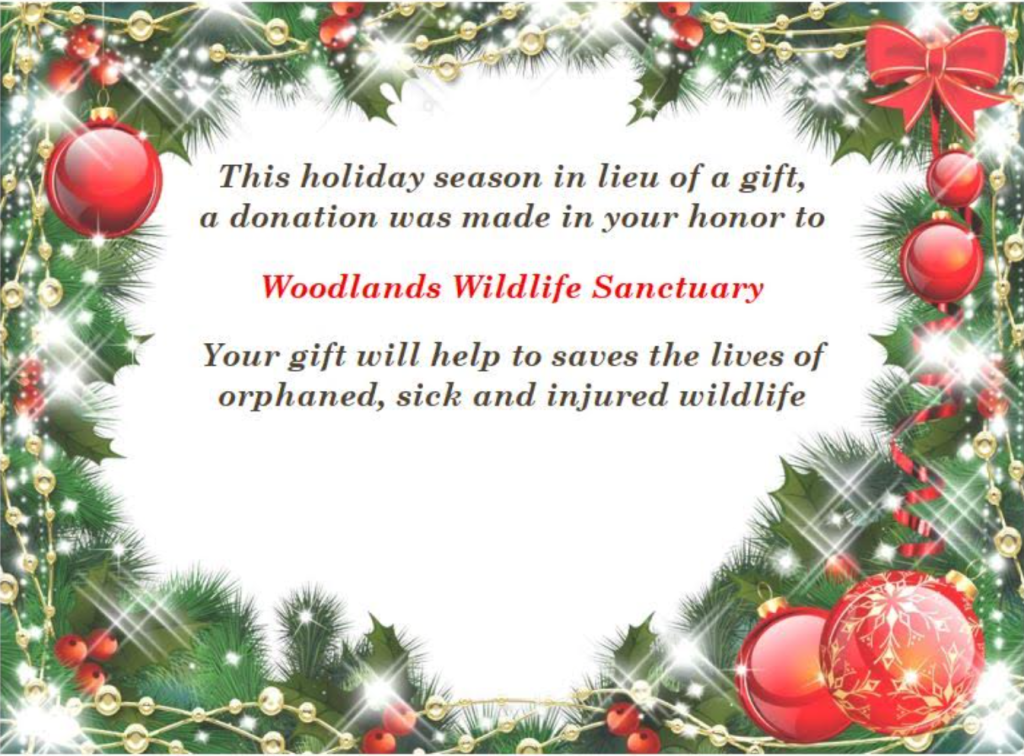
Monika Melichar, founder and director of the Woodlands Wildlife Sanctuary in Minden, Ontario feels it’s important to remind people there are helpful options beyond symbolic adoptions and sponsorships.
WWS is a non-profit charity founded to care for and return orphaned and injured wildlife back to their natural environment. All 45 acres of its secluded wilderness setting, including its treatment facilities and temporary holding shelters, are dedicated to that rehabilitation and release mandate. “We do not ask people to sponsor animals because we are not permitted to keep them,” said Melichar. “Nor do we have the facilities to house wildlife permanently.”
What WWS does have are people who volunteer their time, talents and resources, whether they’re stepping up at the sanctuary, helping with logistics from home, ferrying wildlife in need of transport or ticking off the items on its WISH LIST.

Be assured that while this list happens to be hosted by Amazon Smile, any and all wishes fulfilled directly benefit the sanctuary.
It’s also worth noting that as WWS is an all volunteer organization with no paid staff monetary donations are a critically helpful gift option.
 Cry Wild