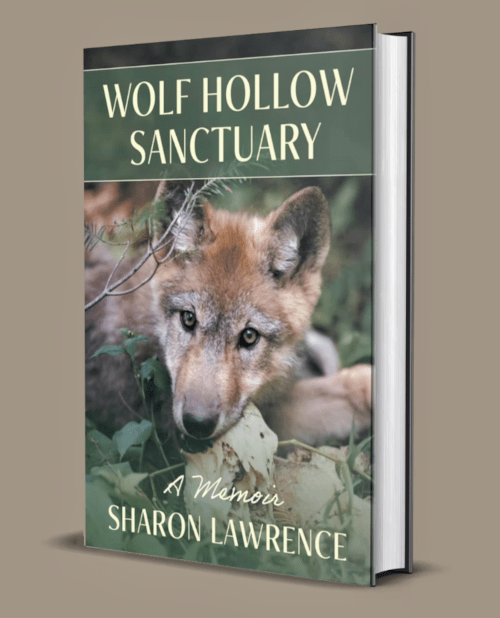
Available online and at local and national booksellers. © 2025 Sharon Lawrence. FriesenPress
What’s it like to bottle feed a wolf pup? Or help heal a fox that’s been gravely injured by a car? Can you imagine the dedicated TLC it takes to earn the trust of a wolf-dog hybrid emotionally and physically abused?
Can you picture yourself devoting your days and nights to the discipline required to manage a wildlife sanctuary? Could you navigate the licensing requirements and meet the learning curve; intellectual and emotional? How about the cost? Financial1, sure, but also physical and even social? Because for every wildlife conservation ally made or wolf-sceptic converted, less informed people remain actively unsympathetic to wolves and wildlife in general. Hence the need for a sanctuary.

Oh, but what a quiet thrill it must be to bottle-feed a wild foundling, to cradle an infant wolf or tiny fawn. You hold them right up against your chest, heart to beating heart, four or more times a day … in between providing comfort and clean bedding, fresh water and medicine and meals, LOTS of meals, an average of 40 to 50 a day, for all the other animals in your care.
The Feeding and Watering of Wolf Hollow Sanctuary.
“Forty to 50 meals a day is a general statement,” clarified Sharon. “Some injured or neglected animals required additional meals every day for a few weeks. Birds and very young mammals were fed every two hours. Mammals on a bottle were fed every four hours. So, we provided all of that in addition to that 40 to 50 meals a day average.
In reality the number of meals and schedule depended on the type of animal and their condition.”
The intensity of KP duty could change with the seasons. Spring means more baby animals and feeding babies is most time consuming.
“Spring was always our busiest time,” said Sharon. By Autumn the number of animals (and therefore required meals) fell in concert with the leaves. “That was the season for releasing animals back into the wilderness or as near to where they were found as possible.”
Even so, Sharon said Winter didn’t necessarily equate to less feedings. “There were always some animals that overwintered because they were not well enough to be released.” That meant that non-hibernating over wintering mammals, raccoons for instance, slept in insulated boxes and received their daily portions. Also, species spending the winter in torpor would stir around January thaw time, and mature animals ready to seek a partner and breed would also have a ready appetite.
How about managing all that for just over two decades? While also opening your doors (and your generous heart) to numerous curious visitors who call and write and earnestly clamour for a chance to visit with the wolves and meet your esteemed author of a husband because they’ve read his books? Can you imagine accomplishing that with the love of your life to the end of his life as he succumbs to Alzheimer’s disease?
Love. And Life. “Wolf Hollow Sanctuary ~ A Memoir” is a love story grounded in a profound respect for life.
Sharon Lawrence’s “tale of tails” (the working title of her book) reflects on the life and lifework she shared with her late husband, Canadian naturalist and wildlife writer, R.D. Lawrence. It also documents the hands-on (often heartwarming but sometimes heart-in-your-mouth) realities of running a wildlife sanctuary ~ a vocation that enriched the many lives, wild and otherwise, who found their way to Wolf Hollow.
As R.D. notably said…
“When your life is touched by wolves, you are changed forever.”

Wolf Hollow Sanctuary circa 1998
So, when life gives you lupins? Open a sanctuary.
Sharon and R.D. Lawrence purchased their 100-acre wilderness property in the Haliburton Highlands of Ontario, Canada in 1984. “It was a unique piece of wilderness,” said Sharon, “with excellent biodiversity: a mix of deciduous and coniferous forest, a waterway, and a variety of mammals, birds, and reptiles. It was also an ideal place for someone like my husband, a field biologist and busy author, to continue his work.”
In addition to its natural attractions, the property featured several outbuildings, including a century old square timber barn. “We planned to renovate the barn,” continued Sharon, “turning the downstairs into an office for Ron and the upstairs into an art studio for my work as a painter and textile artisan.”
But later that year the Lawrences took a break from their renovations to monitor what Sharon described as a “disastrous wolf culling program initiated by the governments of British Columbia, Alaska and the Yukon Territory. ” In lieu of souring this journal entry with spoilers, we’ll leave the details to the memoir’s telling. For now, let’s just say the Lawrences returned to their wilderness property with their first two wolf pups.

Photo provided by Sharon Lawrence © 1984
And then? Well, as anyone who’s volunteered with or worked as a wildlife rescuer knows: word gets out. People hear about you. Animals make their way to you. Whether the universe sends them or local veterinarians and wildlife officers recommend and rely on you…or your contact information appears next to Wildlife Rescue, Rehab and Release… Give a mouse a bandaid and before you know it you’re running a wildlife sanctuary.
“Wolf Hollow Sanctuary housed eleven wolves over the years,” said Sharon, “and a plethora of other wildlife like foxes, raccoons and skunks. There were also mink, porcupines, squirrels and chipmunks. There were snowshoe hare, even a cougar. ” As for domestic animals in need? “We rescued eleven stray cats and three adult dogs.”
“The wildlife division of the Ontario Humane Society often brought us wild animals it had rescued and rehabilitated,” said Sharon. “These were animals deemed ready for a slow release in the months of August, September and October. Our property was ideal for gradual reintroduction to the wild because it offered all those acres of biodiversity, plus access to surrounding wilderness made up of vacant private land and Crown Land. This gave the released animals a large territory to explore.” Even so, the Lawrences set up year-round feeding stations. “If any animals got into trouble, they still could find food.”

As for why animals require such care? Sharon’s Wolf Hollow years offer plenty of insight.
“There are a couple of human behaviors that need mentioning,” she began, “including those that are well-intentioned.”
For instance?
“People who find a young animal they believe is lost or abandoned. They bring it to a sanctuary or other wildlife rescuers because they don’t understand mother animals often leave their baby in a hiding place while they go hunting for food.”
Unlike Wolf Hollow’s pre-internet era, twenty-first century social media and online resources mean there’s less excuse for unnecessarily “rescuing” an infant animal. As Sharon said, “Today’s sanctuaries and animal rescue groups have websites and hotlines that a concerned person can call. They can describe the situation and get advice about what or what not to do. Educating the public is an important and never ending activity.”
Another human behavior that impacts wildlife and domestic animals alike?
“Neglect,” said Sharon. “The neglect and abuse humans inflict upon critters of all species. All the animals that arrived over Wolf Hollow’s 23 years of service had been abused, neglected or injured in some way by humans. And what we learned over those years was this: the neglect and abuse of animals is often the result of misunderstandings, the persistence of myths and a lack of public education. “
As it happens, Sharon worked to counter that last factor during her career as a primary school teacher in Ontario and the Yukon. “I taught from 1962 to 1980, then did supply work in the 80s and 90s,” she said. And she remains a proponent of life-long-learning. “Educate. Educate. Educate, as R.D. used to say. Helping out at a sanctuary offers people a chance to learn about the natural world, to dispel those myths and correct misunderstandings.”
And the gains go beyond the purely intellectual.
“Volunteering at a sanctuary, a wildlife rescue shelter or any animal welfare organization: be it cat and dog, donkey rescue… any of these can be a life-changing experience for a human,” said Sharon. “It is a fabulous way to discover how everything is connected to everything else, and that we humans depend on and thrive in a healthy ecosystem with good biodiversity.”
Exploring, recognizing and nurturing our connection to the natural world was at the core of R.D. Lawrence’s work. Indeed, he wrote more than 30 wildlife conservation books, many of them New York Times Best Sellers. His titles, national and international, include two notable works of fiction, books for youngsters and his memoir, The Green Trees Beyond. His readers might wonder if Sharon’s memoir brings fresh insight or new details to light.
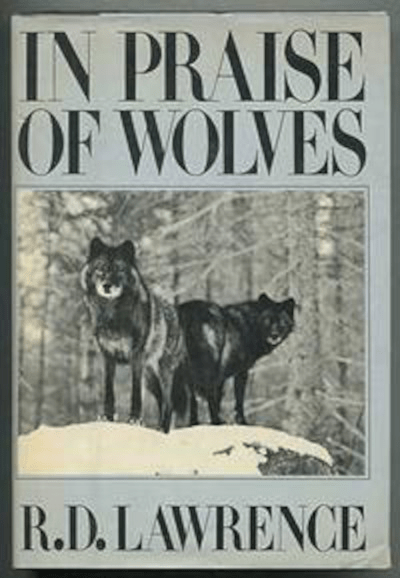
“My memoir is specifically about the Wolf Hollow years,” said Sharon. “It was my job to document the arrival and progress of our residents in writing and with photos. I agreed to be the documentarian because Ron was writing full time. He had deadlines to meet. Yet, he was not specifically writing books about the animals at Wolf Hollow. And, while he did include our first two wolves, Tundra and Taiga, in his book, “In Praise of Wolves,” they don’t appear until the end of that story, when they’re six months old.
“I tell their full story,” continued Sharon. “Their story and those of other animals we rehabilitated and released. Because you see, there were other new and continuing animal stories before and after Ron died in 2003.
“So, in some ways, this memoir will bring closure for me and for fans of R.D. Lawrence,” she said. “He wrote his memoir in 1994 and Owls – The Silent Flyers, in 1997. By 1998 he was working on seven more books which he never completed due to Alzheimers. My memoir will fill in some of the blanks.
“I didn’t write it with any particular message in mind,” added Sharon. “I wrote it because I want people to know about me. Even though I was included in many of Ron’s writings, I want people to know my side of the story in concert with his many tales.”
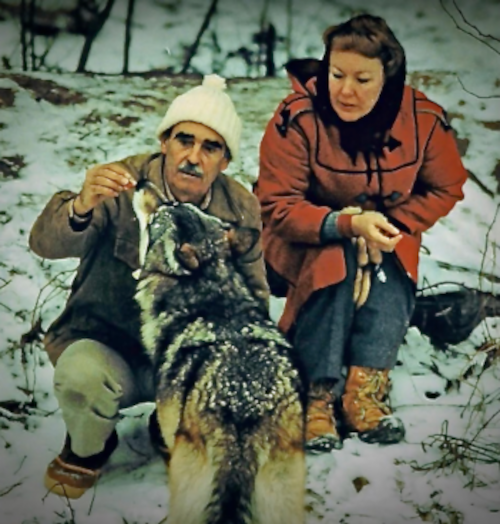
R.D. Lawrence and Sharon with Taiga at Wolf Hollow. Photo credit © Jim Weupper. Slideshow photos are presented courtesy Sharon Lawrence. Their backstories are detailed in her memoir. 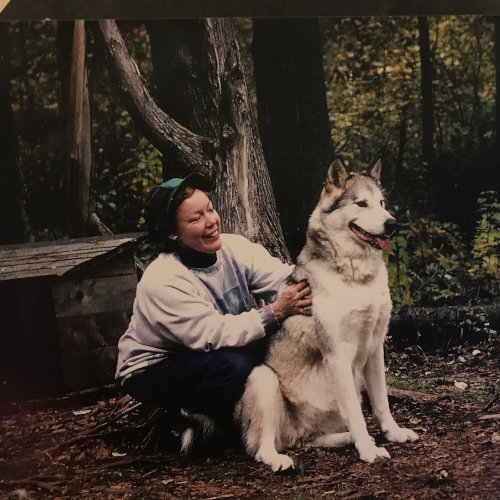
Sharon with wolf-dog hybrid, Shasta. Photo credit © Norm Lightfoot 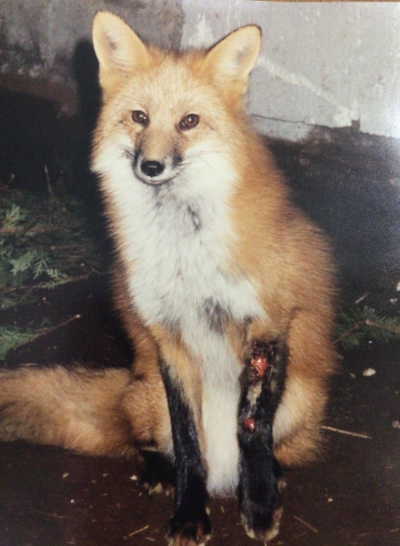
Injured by a car, Zorra benefited from Wolf Hollow’s expertise and TLC. Photo credit © Sharon Lawrence 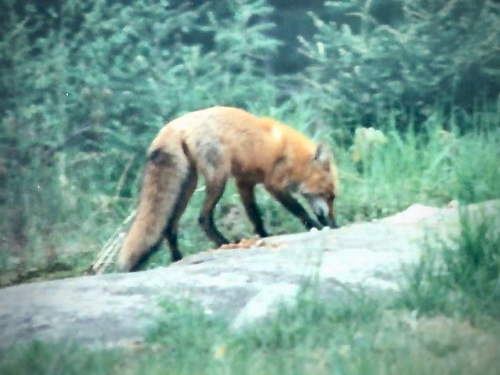
Zorra recovered and was released to the wilderness surrounding Wolf Hollow. Photo credit © Sharon Lawrence 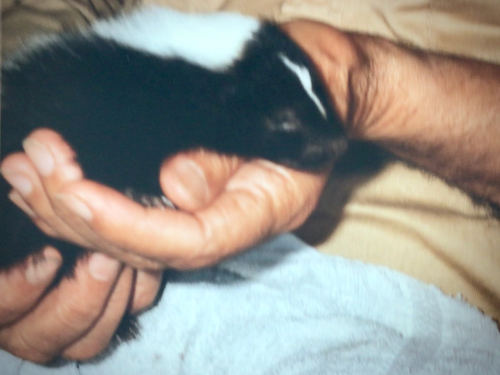
The Lawrences bottle-fed many orphans like this sweet infant skunk, aptly named Cuddles. Photo credit © Sharon Lawrence 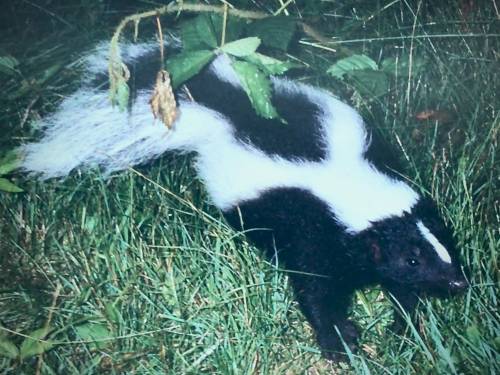
Cuddles thrived and was released into Wolf Hollow’s environs. Photo credit © Sharon Lawrence 
Wolf Hollow Sanctuary cared for this gorgeous mountain lion in the early 90s. Her name was Teca. Photo credit: © Murray Palmer 
Pickles, one of a number of porcupines sheltered and cared for at Wolf Hollow. You’ll have to read the memoir to know why this cutie was named Pickles instead of prickles. Photo credit © Sharon Lawrence 
Sharon found this senior spaniel lying on a local road at the end of a 1990’s hunting season. Seriously ill, unable to walk, Freki was nurtured back to health and lived the rest of his life at Wolf Hollow. Photo credit © R.D. Lawrence 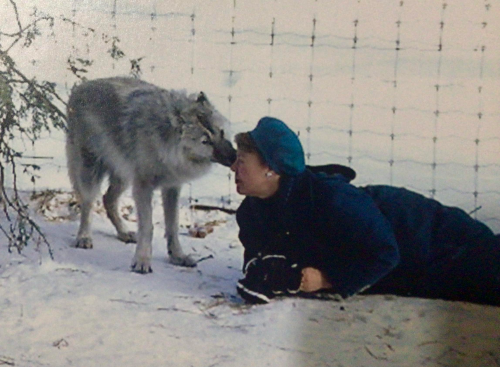
Sharon receives a kiss from the lovely Silva, an Arctic wolf. Photo credit © R.D. Lawrence 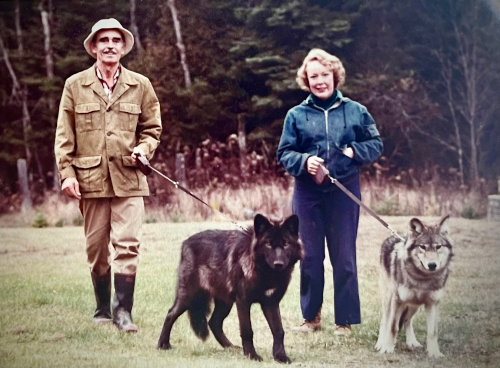
Tundra, with R.D., and Taiga, with Sharon, educated many a Wolf Hollow visitor in the ways of Wolf Etiquette. Photo credit © K Jurgens
These days Sharon volunteers her wealth of Wolf Hollow experience at the Woodlands Wildlife Sanctuary in Minden, Ontario.
“Sharon is here once a week. She helps us by preparing diets for all the hungry wild ones,” said WWS Founder and President, Monika Melichar. “There’s always a fascinating story attached to each bowl she serves, and we thoroughly enjoy hearing her anecdotes about the animals she worked with in the past.”
“I plan on continuing to volunteer at Woodlands, ” said Sharon, “but at 84-years-young, and currently cancer-free, I have ongoing side effects (from treatments received in 2020) that affect my ability to walk distances and stay on my feet for long periods. Every day is a challenge for me.
“That’s one of the reasons I choose to work in sanctuary’s kitchen,” she continued. “My experience lets me do this easily plus I can sit down if I need to. I leave it to younger volunteers to take on the long-distance deliveries outside.”
Not sure how much “sitting down” is happening.
Among Sharon’s many duties? Keeping the kettle boiling to heat bottles and baby-animal formulas. Preparing those formulas and washing nipples and bottles for the next feeding. There’s also frozen fruits, veggies and meats to defrost and make ready for use.
Other fruits and vegetables need to be scrubbed then chopped or grated with the age and health issues of each recipient kept in mind. In the meantime, anything that’s been used outside; syringes, nipples, tubing, bowls and plates, etcetera, needs to be washed and put away as volunteers return them. And, on top of all that, there’s the matter of keeping the fridge organized and ready to receive food that’s prepared for the next morning.
“These kitchen duties are even busier in Spring when lots of baby animals and birds have to be fed every two and four hours all day long,” said Sharon.
“But with the kitchen clean, tidy and organized and the food prep done, ” she continued, “the other volunteers can deliver food and bottles immediately, without having to stop to wash dishes or prep the next meal. That enables these activities to move along smoothly and more efficiently.”
Even so, with three or four WWS volunteers constantly returning items to the kitchen the clean-up is non-stop and doesn’t let up till late afternoon.
Melichar, a federally and provincially Authorized Wildlife Custodian with a BSc in Zoology, said, “Sharon’s Wolf Hollow years mean she understands first-hand the challenges we face working with wildlife. And, just like a den mother, and with such grace and elegance, she is always ready to dish out wise words of advice that help to keep us on an even keel. Having Sharon Lawrence helping us at the sanctuary is truly a gift and a great honour.”
It should also be noted that Sharon’s efforts in the kitchen enable the other volunteers to take a turn bottle-feeding Woodland’s baby animals.
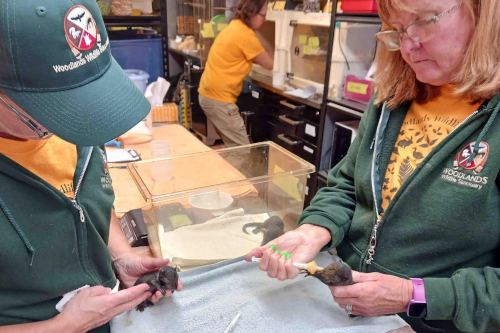
photo credit © Woodlands Wildlife Sanctuary 2025
“That’s what most people enjoy, not preparing food or cleaning up the kitchen,” said Sharon. “I’ve had more than 20 years of handling wildlife. I’ve experienced the joy and awe of bottle feeding a baby animal. But I never had help in the kitchen so I know the importance of this task.”
Which really does place Sharon in the position to answer the question at the top of this journal entry. From soup to nuts, what IS it like to run a wildlife sanctuary?
Sharon mused, “Most everybody loves animals. But some people romanticize rescue and rehabilitation work. They think having a sanctuary and caring for animals is a glamorous job. I want to offer a realistic account. My memoir lets people know that it is challenging work; physically, emotionally. It’s often very stressful and bittersweet. You can’t always fix the human mistakes and that makes one angry. On the other hand, there are certainly many joys and rewards to be gained through successful wildlife rehabilitation. Something many experience when rescuing or re-homing a stray cat or dog.”
Sharon reconsidered the question of her memoir offering a message and said, “I think it’s this. This book demonstrates the hard work, patience and sense of humour required to be a caregiver. It shares the emotions, the understanding gained and yes, the rewards one derives whether caring for a four-legged critter or two-legged human. Being a caregiver is not an easy job, no matter who the patient is, but for more than 20 years this was my typical day.”
Sharon Lawerence’s “Wolf Hollow Sanctuary ~ A Memoir,” is available online and at local and national booksellers. © 2025 Sharon Lawrence. FriesenPress
- Click the arrow below to read Sharon’s breakdown of Wolf Hollow Sanctuary’s average annual expenditures.
↩︎
Wolf Hollow Sanctuary operating costs
“Keeping in mind that at the time, 1984 to 2005, food and other prices were very different than they are today, we probably spent an annual $6,000 on food and another $3,000 to $4,000 on veterinarian care.
“We did receive ‘out of code’ (items deemed unfit for consumption) grocery donations; vegetables and fruit from grocery stores aware of our work. The local Haliburton Butcher Shop provided deer and moose scraps during hunting season and the folks at Haliburton Forest donated beaver meat.
As for medications and other supplies? “Some of these were donated by the Ontario Society for the Prevention of Cruelty to Animals when they delivered an animal into our care. The OSPCA Wildlife Division usually covered any expensive surgeries. “
Looking back on the means and ways of Wolf Hollow’s era, Sharon said, “Most sanctuaries today are registered not-for-profit organizations with fundraising abilities. They also have volunteers and paid staff whoare accountable to the Ministry of Natural Resources. That entails a lot of paperwork. They must account for each animal helped, number them, track their history, their care, progress and release. This is especially critical when dealing with at risk species and also another huge project a sanctuary must undertake,. Thankfully there are qualified, business volunteers who can document and submit this information. “Costs and the ways to handle them are very different these days, but overall, with volunteering, fundraising and accountability measures in place, I think the situation is better in some ways.”
For instance, a current non-profit wolf sanctuary, The Wolf Conservation Centre of Salem, NY lists its accountability and finance information at the charitable contribution rating website: Charity Navigator.
The WCC’s mission statement, its financial metrics: revenue vs. expenses, working capitol and fundraising efficiency are all visible to potential donors and volunteers. There’s even a chart that the displays the “trend of revenue and expenses over the past several years for this organization, as reported on its IRS Form 990.” If you’re curious, the WCC reported $3,384,804 in revenue and $1,919,124 in expenses in 2022.
 Cry Wild